
Diamond Quilted vs. Honeycomb Mesh Saddle Pads: Moisture-Wicking Fiber GSM, Spine Relief & Pressure Distribution
Textile engineering of dressage and jumping saddle pads: 350 GSM diamond-quilted cotton velvet, 3D spacer mesh spine channels, and high-density foam shock absorption.
On this page (11)
- Diamond Quilted vs. Honeycomb Mesh Saddle Pads: Moisture-Wicking Fiber GSM, Spine Relief & Pressure Distribution
- Executive Overview and B2B Procurement Context
- Functional Difference Between Diamond Quilting and Honeycomb Mesh
- Material and Layer Engineering
- Technical Comparison: Diamond Quilted and Honeycomb Mesh Saddle Pads
- Pressure Distribution and Equine Biomechanics
- Manufacturing and Quality Control Checkpoints in Sialkot
- Related Leather, Metal, and Equine Veterinary Tool Engineering
- Buyer RFQ and OEM Ordering Checklist
- Selection Guidance for Distributors and Professional Buyers
- OEM and Wholesale Enquiries
Diamond Quilted vs. Honeycomb Mesh Saddle Pads: Moisture-Wicking Fiber GSM, Spine Relief & Pressure Distribution
Executive Overview and B2B Procurement Context
For a saddle pad manufacturer, tack distributor, professional rider, farrier, or equine veterinary hospital, the difference between diamond quilting and honeycomb mesh is not merely visual. The selected face fabric, foam architecture, felt density, lining geometry, anatomical topline, and girth-zone reinforcement determine how efficiently the pad manages sweat, limits saddle displacement, protects the thoracic back, and maintains dimensional stability after repeated washing.
Equestrian Max manufactures OEM and ODM saddle pads in Sialkot using controlled textile specifications rather than retail-grade fabric descriptions. A robust production specification for this category consists of a 300–400 GSM micro-velvet or cotton twill shell, a nominal 15 mm open-cell foam layer bonded to a 300 GSM felt core, and a three-dimensional honeycomb air-mesh lining that creates ventilation channels beneath the saddle. The pad should also incorporate an anatomical top line with defined wither clearance and reinforced 600D polyester girth guard patches.
Diamond quilting remains valuable where a distributor requires a stable, structured pad with consistent foam retention and a premium appearance. Honeycomb mesh is generally preferable where rapid sweat evacuation, lower contact-area moisture accumulation, and improved air exchange are the primary requirements. In either design, pad geometry must complement the saddle tree, panel shape, girth position, and individual horse anatomy. A thick pad cannot correct an unsuitable saddle fit.
For professional and institutional buyers, the specification should also document colorfastness, dimensional tolerances, abrasion resistance, foam compression behavior, seam security, washing instructions, and traceability by production lot. The product must not interfere with the saddle’s stability or create excessive localized loading along the withers, thoracic spine, scapular region, or caudal saddle-bearing area.
Functional Difference Between Diamond Quilting and Honeycomb Mesh
Diamond Quilted Construction
Diamond quilting is a stitched or heat-assisted channel layout that divides the shell, batting, foam, and felt into repeatable load cells. A correctly engineered diamond pattern prevents the foam and felt from migrating toward the rear of the pad during riding and laundering. It also creates a predictable visual and dimensional structure for private-label collections.
The principal engineering limitation is that quilting compresses the internal stack at each stitch line. These compressed lines can reduce local thickness and form linear pressure transitions if the stitch pitch is too narrow, the thread tension is excessive, or the quilting pattern is not aligned with the saddle panel. For a 15 mm foam layer, a practical quilting specification should state a stitch pitch of approximately 70–100 mm, a stitch-line tolerance of ±3 mm, and controlled thread tension that does not reduce the finished foam height by more than 10% at the quilt line.
Honeycomb Mesh Construction
Three-dimensional honeycomb air-mesh uses raised knitted filaments to form vertical ventilation cells between the horse’s back and the pad. The open structure allows sweat vapor and air to move laterally and vertically, provided that the saddle panel does not fully collapse the mesh. Honeycomb mesh is especially useful in warm climates, high-intensity schooling, endurance use, and facilities where pads are washed frequently between horses.
The lining should have a stable cell height, typically 3–5 mm for a saddle pad, with a finished mass commonly between 180 and 300 GSM depending on filament diameter and open-area ratio. A production specification should identify the open-area target, cell height, wicking performance, abrasion resistance, and dimensional recovery after laundering. A mesh that is too soft can collapse beneath the saddle; a mesh that is too rigid can create a harsh transition around the scapula or loin.
Material and Layer Engineering
300–400 GSM Shell Fabrics
The outer shell may be produced in 300–400 GSM micro-velvet or cotton twill. Micro-velvet provides a dense, soft hand, strong color presentation, and a smooth surface suitable for embroidery, piping, and private-label branding. Cotton twill provides a traditional textile appearance and good stitch receptivity, but requires controlled shrinkage and colorfastness testing because cotton absorbs more moisture than synthetic velvet.
- Micro-velvet target: 300–400 GSM, polyester or polyester-rich construction, fabric weight tolerance ±5%, width tolerance ±2%, and finished shrinkage preferably below 3% in length and width after the specified wash cycle.
- Cotton twill target: 300–400 GSM, combed cotton or cotton-rich blend, twill line free from bowing and skew beyond 3% of fabric width, with shrinkage declared separately for length and width.
- Colorfastness: specify a minimum Grade 4 for dry and wet crocking where practical, with perspiration and laundering results recorded by production lot.
- Surface stability: no visible slubs, needle lines, oil contamination, glazing, or pile direction change in the finished inspection area.
GSM must be measured from conditioned samples rather than estimated from a supplier catalogue. A practical incoming inspection protocol conditions samples at approximately 20°C and 65% relative humidity before weighing. Five or more specimens should be taken from different fabric zones, with the mean result recorded against the approved range.
15 mm Open-Cell Foam and 300 GSM Felt Core
The shock-damping layer should use nominal 15 mm open-cell polyurethane foam bonded to a 300 GSM felt core. Open-cell foam permits progressive compression and recovery while reducing the abrupt rebound associated with some closed-cell foams. The foam specification should identify density, hardness, compression set, thickness, cell uniformity, and adhesive compatibility.
- Foam thickness: 15.0 mm nominal, recommended finished tolerance ±1.5 mm before quilting and ±2.0 mm after quilting.
- Foam density: commonly 35–45 kg/m³ for a balanced saddle-pad shock-damping layer; the exact target should be validated against the saddle panel and intended discipline.
- Hardness: specify a Shore 00 or compression-force-deflection value rather than using the term “soft” or “firm.” A buyer may request 25% compression-force-deflection testing with a defined laboratory method.
- Compression set: target no greater than 10–15% after a defined heat and load exposure, subject to the selected foam chemistry and test method.
- Felt core: 300 GSM nominal, ±5% weight tolerance, uniform calendering, no hard lumps, and a consistent loft across the saddle-bearing area.
- Bonding: adhesive coverage should be continuous enough to prevent delamination but not so heavy that it closes the foam cells or creates rigid adhesive ridges.
Thickness alone does not predict pressure behavior. The assembled pad should be evaluated under the actual saddle panel geometry. Excessive thickness can raise the saddle, reduce stability, alter the effective tree width, and concentrate force at the front or rear panel edges. The best construction is the one that preserves even contact without compromising the saddle’s original fit.
3D Honeycomb Air-Mesh Lining
The lining should use a knitted three-dimensional spacer mesh with a defined air channel and moisture transport path. The sweat-facing surface should be hydrophilic enough to spread moisture, while the opposite surface should permit evaporation into the surrounding air. A practical buyer specification may include a moisture-management test such as AATCC 195 or an equivalent laboratory method, with results reported for wetting time, absorption rate, spreading speed, and one-way transport.
For institutional purchasing, the following targets are useful starting points rather than universal legal requirements:
- 3–5 mm finished mesh cell height.
- 180–300 GSM lining weight, depending on construction.
- Open-area ratio documented by the supplier, preferably verified by image analysis or controlled microscopy.
- Dimensional change after five specified wash cycles of no more than 5% in length and width.
- Surface abrasion resistance sufficient to withstand repeated contact with the horse’s coat and regular saddle-pad laundering.
- No exposed monofilament ends, sharp mesh edges, loose loops, or hard joining points in the wither and spine channels.
Anatomical Top Line and Wither Relief
The topline should follow the horse’s dorsal contour while leaving a clear, stable channel over the dorsal spinous processes. The front arch must rise over the withers without folding inward when the saddle is tightened. The precise height and angle depend on breed, saddle tree, panel depth, and the horse’s musculature; therefore, an OEM pattern should be approved against a physical sample saddle rather than a two-dimensional drawing alone.
For a general English saddle pad, the central spine channel may be specified at approximately 50–80 mm finished width, with the front relief rising progressively rather than forming an abrupt step. The top-line seam should be placed away from the central dorsal contact zone. A front reinforcement or binding must not create a hard ridge behind the scapula, where the cranial thoracic region requires unrestricted movement during protraction of the forelimb.
Fit approval should include a static check and a ridden check. Inspectors should examine clearance at the withers, freedom behind the scapula, pad stability under the girth, contact at the front and rear panel zones, and any localized sweat pattern suggesting uneven loading. Sweat marks are useful observational evidence but are not a substitute for a properly calibrated pressure-mapping assessment.
600D Polyester Girth Guard Patches
The girth guard should use 600D polyester with a tightly woven base, controlled coating, and abrasion-resistant finish. The patch must extend far enough to protect the shell and lining from billet and girth friction without creating a bulky ridge under the horse’s ribcage.
- Fabric: 600 denier polyester, weight and coating level declared on the approved bill of materials.
- Patch placement: symmetrical within ±3 mm between left and right sides unless the pattern is intentionally asymmetrical.
- Edge treatment: bound, folded, or bartacked edges with no exposed cut yarns.
- Stitching: lockstitch or equivalent, typically 8–12 stitches per 25 mm, with reinforced bartacks at high-load ends.
- Durability: no tearing, edge lifting, or seam opening after the agreed cyclic abrasion and pull test.
Technical Comparison: Diamond Quilted and Honeycomb Mesh Saddle Pads
| Specification | Diamond Quilted Pad | Honeycomb Mesh Pad | Procurement Control | Primary Application |
|---|---|---|---|---|
| Outer shell | 300–400 GSM micro-velvet or cotton twill; quilted into repeatable diamond cells | 300–400 GSM micro-velvet or cotton twill; shell supported by a breathable spacer lining | GSM tolerance ±5%; shrinkage, crocking, shade, and fabric-width approval | Retail collections, schooling, competition presentation, private-label branding |
| Shock-damping stack | 15 mm open-cell foam bonded to 300 GSM felt core | 15 mm open-cell foam bonded to 300 GSM felt core, with air-mesh beneath | Foam thickness ±1.5 mm before quilting; density and compression-set report required | General English riding, training, and controlled pressure distribution |
| Moisture management | Moisture must pass through quilt channels and the shell system; performance depends strongly on fabric selection | 3D honeycomb lining spreads sweat and supports vertical and lateral air movement | AATCC 195 or equivalent wicking data; wash-cycle dimensional recovery | Warm climates, high-workload horses, frequent laundering |
| Internal stability | Excellent resistance to foam and felt migration when stitch pitch and thread tension are controlled | Requires secure lamination and edge stabilization to prevent mesh shift or collapse | Layer peel check, seam inspection, and post-wash dimensional audit | Quilted appearance and repeatable OEM production |
| Wither and spine relief | Anatomical topline must be cut and quilted so diamond seams do not cross the central relief channel | Mesh must maintain channel height beneath the saddle and remain free of hard seam ridges | Pattern tolerance ±3 mm; physical saddle-fit approval and ridden sample review | Horses requiring clear dorsal and cranial thoracic clearance |
| Girth protection | 600D polyester guard patches protect the shell from billet and girth abrasion | 600D polyester guard patches protect both shell and moisture-management lining | Patch position ±3 mm; bartack, seam-pull, and abrasion verification | Daily training, school horses, commercial yards |
| Maintenance profile | Usually retains shape well, but dense quilting can slow drying if the shell absorbs sweat | Faster air circulation and drying when mesh remains open and is not overloaded with adhesive | Defined wash temperature, detergent, spin speed, drying method, and five-cycle inspection | Distributors requiring repeatable care instructions and low returns |
Pressure Distribution and Equine Biomechanics
The saddle pad sits over the thoracic region, where the longissimus dorsi, trapezius, latissimus dorsi, and epaxial tissues interact with the saddle panels and the horse’s movement. The pad must preserve the saddle’s intended panel contact while reducing abrupt force transitions. It should not bridge across the back, lift the saddle excessively, or press into the dorsal spinous processes.
At the cranial end, the pad must clear the scapular cartilage and permit the shoulder blade to rotate and slide beneath the saddle’s front panel during forelimb protraction. At the caudal end, the pad should not fold into the loin or create a rear wedge that increases rocking. A central spine relief channel should remain open after girthing and after the rider is mounted.
For OEM validation, Equestrian Max can work from a representative saddle and horse-back profile, followed by static fit review, ridden observation, and, where required, pressure-distribution assessment using an equine saddle pressure system. Buyers should define acceptance criteria in terms of repeatability and absence of localized peak loading rather than demand an arbitrary universal pressure value. Results vary with rider mass, saddle tree, horse conformation, gait, speed, and pad compression.
Manufacturing and Quality Control Checkpoints in Sialkot
Incoming Material Inspection
- Verify shell GSM from multiple conditioned specimens and record mean, minimum, and maximum values.
- Check fabric width, skew, bowing, shade consistency, pile direction, and visible surface defects under controlled lighting.
- Measure foam thickness at a minimum of five points per sheet and reject material with hard spots, excessive density variation, or surface contamination.
- Confirm felt weight, loft uniformity, moisture condition, and roll identification.
- Inspect 3D mesh for cell-height variation, loop defects, damaged filaments, and open-area consistency.
- Confirm 600D polyester girth-guard fabric, coating integrity, and color compatibility with the approved sample.
Cutting and Lamination Control
Computer-assisted or calibrated template cutting should maintain pattern dimensions within ±3 mm for major panels. Left and right panels should be matched before stitching. The topline, spine channel, girth guard, logo placement, and binding path must be checked against the approved master pattern.
Lamination should use an adhesive compatible with polyurethane foam, polyester, cotton, felt, and spacer mesh. Operators must control adhesive quantity, curing time, press temperature, and press pressure. Excess adhesive may close open cells, reduce breathability, stiffen the pad, and create localized hardness. Insufficient adhesive can cause bubbling, delamination, or foam migration after washing.
Stitching and Assembly Inspection
- Confirm quilting pitch and cell alignment against the technical drawing.
- Maintain stitch density typically between 8 and 12 stitches per 25 mm unless the approved design states otherwise.
- Inspect thread tension for puckering, skipped stitches, thread breaks, and compressed foam ridges.
- Check binding width, corner radii, and the absence of exposed raw edges.
- Verify girth guard symmetry and bartack placement within the approved tolerance.
- Measure finished length, drop, spine-channel width, topline rise, and girth-zone position.
Durability and Finished-Product Verification
Finished pads should undergo a documented inspection before packing. At minimum, the inspection should include visual workmanship, dimensional conformity, layer adhesion, seam security, label accuracy, and packaging protection. A sample from each production lot should undergo laundering according to the declared care instruction, followed by inspection for shrinkage, color transfer, foam displacement, edge curling, mesh collapse, and seam opening.
Useful laboratory references include ISO 13934-1 for strip tensile behavior, ISO 12947 for textile abrasion, ISO 105-X12 for crocking, ISO 105-C06 for laundering colorfastness, ISO 6330 for domestic washing procedures, and ISO 811 for water penetration where a water-resistant outer finish is specified. The applicable method and acceptance level must be agreed in the purchase order; a test reference without a declared pass threshold is not a complete quality specification.
Related Leather, Metal, and Equine Veterinary Tool Engineering
Where a saddle-pad program is supplied alongside bridles, girths, halters, bits, or veterinary instruments, the same lot-control discipline should extend to leather and metal components.
Vegetable Drum-Dyed Argentine Cowhide
For leather trim, billet keepers, bridle components, or matching saddlery, specify vegetable-tanned Argentine cowhide by thickness, fiber structure, tannage, and finish rather than by country of origin alone. A practical specification is 1.4–1.8 mm finished thickness for medium-weight trim, thickness tolerance ±0.15 mm, vegetable tannage with drum dyeing, and a controlled moisture range of approximately 12–18% at conditioned inspection.
Leather should be checked for loose grain, excessive belly fiber, flesh-side contamination, dye penetration, finish adhesion, flex cracking, and color transfer under wet and dry rubbing. Buyers should request traceability for hide source, tanning batch, drum-dye lot, and finishing batch. Argentine cowhide intended for equestrian use should maintain sufficient tear resistance and flex durability for repeated bending around buckles and keeper loops.
Metal Components for Adjacent Tack and Tool Programs
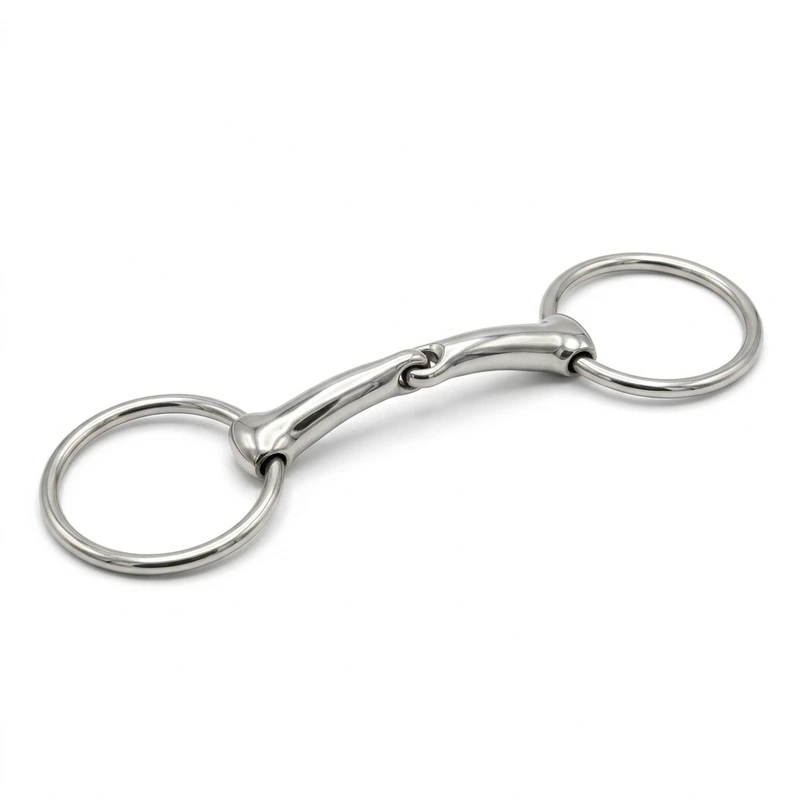
For high-copper German Silver, commonly known as Argentan or nickel silver, a typical engineering composition is approximately 60% copper, 20% nickel, and 20% zinc, with the exact alloy certificate stated in the purchase order. The alloy should be free from sharp casting defects and polished consistently. For bits, cheek pieces, and decorative hardware, buyers should also specify mouthpiece diameter, edge radius, surface finish, dimensional tolerance, and corrosion-resistance expectations.
AISI 420 stainless steel used for equine dental instruments and other veterinary tools commonly contains approximately 12–14% chromium with carbon controlled according to the selected 420 grade. The heat-treatment condition, hardness range, passivation, edge geometry, and surface roughness must be stated separately. Chrome Vanadium drop-forged steel is appropriate for farrier tools where impact resistance and controlled hardness are required; the buyer should request the exact mill chemistry, forging condition, hardness range, jaw alignment, and handle retention method rather than accepting “forged steel” as a sufficient description.
These specifications support coordinated procurement across English saddles and saddlery, horse bits and bridles, farrier and hoof-care tools, and equine dental instruments.
Buyer RFQ and OEM Ordering Checklist
- Product profile: state English saddle-pad discipline, saddle size range, intended horse population, and whether the pad is for schooling, competition, endurance, therapeutic evaluation, or commercial-yard use.
- Shell fabric: select 300–400 GSM micro-velvet or cotton twill; specify fiber composition, color standard, finish, shrinkage limit, colorfastness requirement, and logo or embroidery location.
- Internal stack: specify 15 mm open-cell foam, foam density, hardness method, compression-set limit, adhesive type, and 300 GSM felt-core tolerance.
- Lining: specify 3D honeycomb mesh GSM, cell height, open-area requirement, wicking test method, abrasion requirement, and dimensional recovery after laundering.
- Pattern: provide saddle panel measurements, topline profile, spine-channel width, front wither rise, rear drop, girth position, and approved physical saddle reference.
- Quilting: define diamond-cell dimensions, stitch pitch, thread material, thread color, stitch tolerance, and maximum acceptable foam compression at stitch lines.
- Girth guard: specify 600D polyester, patch dimensions, coating, location tolerance, edge construction, thread, bartack pattern, and abrasion requirement.
- Fit approval: require a pre-production sample for static saddle fit, wither clearance, scapular freedom, pad stability, and ridden evaluation before bulk production.
- Testing: list required textile references, wash cycle, drying method, peel or delamination check, seam-pull requirement, colorfastness threshold, and lot sampling plan.
- Packaging: specify folding method, moisture barrier, carton dimensions, barcode or SKU system, care label language, country-of-origin marking, and private-label packaging.
- Compliance file: request the approved bill of materials, material certificates, inspection report, test reports, production-lot identification, and retained reference sample.
- Commercial terms: define minimum order quantity, size and color ratio, sample charge, lead time, replacement policy, inspection responsibility, and approved tolerance schedule.
Selection Guidance for Distributors and Professional Buyers
Choose a diamond-quilted construction when structural stability, repeatable appearance, embroidery, and foam retention are the leading commercial requirements. Choose a honeycomb-mesh construction when rapid drying, sweat transport, and warm-climate use are more important. For many professional programs, the strongest range strategy is to offer both constructions using the same anatomical pattern and core stack, allowing the distributor to differentiate by climate, discipline, and price tier.
The pad should always be evaluated with the intended saddle, girth, rider, and horse type. A breathable lining cannot compensate for a bridging saddle, an over-tight girth, excessive rider imbalance, or inadequate wither clearance. The correct manufacturing target is controlled contact, stable positioning, moisture management, and preservation of normal shoulder and thoracic movement.
OEM and Wholesale Enquiries
Equestrian Max can develop private-label saddle pads from an approved pattern, physical saddle reference, color standard, and written performance specification. Buyers may review the wider range through Equestrian Max products, compare English saddles and saddlery, or coordinate a broader tack and equine-tool program covering horse bits and bridles, farrier and hoof-care tools, and equine dental instruments.
For a technical quotation, send the required shell GSM, foam and felt construction, honeycomb mesh parameters, anatomical measurements, girth-guard dimensions, testing requirements, color references, target quantity, and destination market through the Equestrian Max contact page.
Related Categories & Sourcing Hubs
Ustad Rashid Mahmood
Master English Saddlery & Vegetal Leather Tree Architect
Reviewed against FEI tack regulations, high-copper German Silver bit metallurgy, Chrome-Vanadium farrier forging, and equine dental standards.

