
German Silver vs. Stainless Steel Horse Bits: Salivation Biomechanics, Copper Content & FEI Rulebook Compliance
Metallurgical analysis of high-copper German Silver (Argentan) vs AISI 304 stainless steel mouthpieces: thermal conductivity, sweet taste salivation, and FEI legal alloys.
On this page (11)
- German Silver vs. Stainless Steel Horse Bits: Salivation Biomechanics, Copper Content & FEI Rulebook Compliance
- Executive Overview and B2B Procurement Context
- Material Chemistry and Metallurgical Behaviour
- Salivation Biomechanics and Equine Mouth Contact
- Technical Comparison of Common Bit Materials and Mouthpiece Specifications
- Mouthpiece Thickness: 14 mm, 16 mm, and 18 mm
- FEI Dressage and Rulebook Compliance
- Manufacturing and Quality Control in Sialkot
- Leather and Bridle Interface Specifications
- Buyer RFQ and Wholesale OEM Ordering Checklist
- Procurement Conclusion and Equestrian Max Manufacturing Support
German Silver vs. Stainless Steel Horse Bits: Salivation Biomechanics, Copper Content & FEI Rulebook Compliance
Executive Overview and B2B Procurement Context
Horse-bit material is not a cosmetic choice. Alloy chemistry influences surface oxidation, thermal conductivity, saliva wetting, perceived mouth comfort, cleaning requirements, and the long-term stability of the mouthpiece and cheek assemblies. For tack distributors, professional riders, farriers, equine veterinary hospitals, and private-label equestrian brands, the correct specification must combine alloy verification, mouthpiece geometry, manufacturing tolerances, welfare requirements, and the current rules of the intended competition discipline.
German Silver, as specified in this guide, is a copper-rich alloy containing 65% copper, 23% zinc, and 12% nickel by mass. It is not sterling silver and contains no elemental silver. The name describes its silver-coloured appearance. Aurigan is a proprietary copper-based alloy whose exact commercial formulation and permitted use must be confirmed with the alloy owner or supplier; commonly published descriptions identify approximately 85% copper with silicon and zinc additions, but an OEM should not treat an approximate trade description as a certified chemical specification. AISI 304 stainless steel is an austenitic chromium-nickel steel, normally specified around 18% chromium and 8% nickel, with the balance principally iron and controlled carbon, manganese, silicon, phosphorus, sulfur, and nitrogen.
For wholesale procurement, the important question is not simply whether a bit is “copper” or “stainless.” The buyer should define alloy grade, material certificate, mouthpiece diameter, edge radii, joint profile, cheek geometry, surface finish, nickel disclosure, production tolerance, cleaning instructions, packaging, and the rulebook applicable to the destination market.
Material Chemistry and Metallurgical Behaviour
German Silver: 65% Copper, 23% Zinc, 12% Nickel
The specified German Silver composition is a copper-zinc-nickel alloy. Copper contributes thermal conductivity and a relatively high resistance to corrosion in ordinary atmospheric conditions. Zinc improves castability and contributes to strength and hardness. Nickel improves the silver-white appearance, corrosion resistance, and structural stability of the alloy.
An OEM specification should identify the composition as a mass-percentage target and include a production tolerance. A practical purchasing requirement is Cu 65.0% nominal, Zn 23.0% nominal, and Ni 12.0% nominal, with each elemental result verified by X-ray fluorescence or an equivalent validated laboratory method. For a high-volume bit program, the buyer may request an elemental acceptance band of ±1.0 percentage point for each principal element, provided the resulting alloy remains mechanically and chemically suitable for the approved design.
Nickel disclosure is essential. Horses vary in their response to metal contact, and the finished product should not be marketed as nickel-free. Surface polishing can reduce roughness but does not remove nickel from the alloy. Suppliers should provide a material declaration and avoid unsupported claims that a copper-nickel alloy will increase salivation in every horse.
Aurigan
Aurigan is a proprietary trade alloy rather than a generic AISI or EN grade. Its commercial attraction is the high copper content and the warm gold appearance produced by its alloy balance. Published descriptions commonly identify approximately 85% copper with silicon and zinc additions, but the exact formula, heat treatment, hardness range, and surface condition should be obtained from the authorized material source.
For OEM production, “Aurigan” should only be stated on product literature when the alloy is purchased through an authorized source and traceability is retained. If a factory produces a comparable copper alloy, it should be described by its verified chemical composition rather than using the proprietary name.
AISI 304 Stainless Steel
AISI 304 is typically specified with approximately 17.5–20.0% chromium and 8.0–10.5% nickel, with carbon commonly controlled to a maximum of 0.08% for standard 304. A low-carbon 304L variant is generally specified at a maximum of 0.03% carbon. The balance is iron with controlled manganese, silicon, phosphorus, sulfur, and nitrogen.
Stainless steel does not mean chemically inert in every environment. Equine saliva contains water, electrolytes, proteins, and organic acids. Chloride-bearing residues, inadequate rinsing, crevices around joints, and prolonged damp storage can promote staining or localized corrosion. A properly finished 304 bit should have a continuous, smooth surface without pits, burrs, exposed grinding marks, or crevice traps.
Salivation Biomechanics and Equine Mouth Contact
The bit rests within the interdental space, between the incisors and cheek teeth. The tongue occupies much of the oral cavity and lies over the bars in many rein positions. The bars are covered by thin oral mucosa over bone, with limited soft-tissue protection compared with the fleshy tongue. Bit pressure is therefore affected by mouthpiece diameter, joint location, rein tension, cheek leverage, tongue thickness, palate shape, dental balance, head position, and the rider’s hand.
A thicker mouthpiece does not automatically create lower pressure. A larger diameter can distribute contact over a wider surface, but it also occupies more oral volume and may increase tongue compression in a horse with a low palate or a large tongue. A narrow mouthpiece can concentrate pressure more sharply, especially if the edges, joints, or cheek transitions are poorly designed. Correct fit must be assessed with the horse’s dental condition, tongue space, palate shape, bit position, and the discipline rules in view.
Salivation and Copper-Rich Alloys
Copper-rich alloys can encourage active mouthing in some horses because the surface warms quickly, develops a distinctive metallic taste, and interacts with saliva as the horse moves the tongue. This is an observed behavioural response, not a guaranteed physiological result. Salivation also depends on hydration, stress, dental comfort, bit fit, rein contact, diet, and individual behaviour.
Saliva is an electrolyte, so metal surfaces can participate in electrochemical reactions. Copper, zinc, nickel, and iron-based alloys have different electrode potentials. When dissimilar metals are electrically connected through a wet saliva film, a galvanic cell may form. In practice, the risk is greatest at dissimilar-metal joints, damaged plating, unpassivated steel, and contaminated crevices. A single homogeneous mouthpiece generally presents less galvanic complexity than a multi-metal assembly.
Manufacturers should avoid bare dissimilar-metal contact where it can create staining, accelerated local attack, or rough deposits. If stainless steel rings are combined with a copper alloy mouthpiece, the joint should be mechanically smooth, cleanable, and designed to avoid sharp crevice gaps. No bit should be released with green copper salts, flaking deposits, pitting, sharp corrosion, or a roughened contact surface.
Thermal Conductivity and Perceived Warmth
Copper-rich alloys conduct heat substantially more efficiently than austenitic 304 stainless steel. This allows a copper alloy to exchange heat with the horse’s mouth more rapidly after insertion. The horse may perceive a copper alloy as warmer or less cold than stainless steel, particularly when both bits begin at the same stable temperature.
Perceived warmth is not determined by conductivity alone. It also depends on starting temperature, mass, wall thickness, saliva wetting, airflow, storage conditions, and the duration of contact. A cold copper alloy can initially feel cold; it simply approaches oral temperature more quickly. Buyers should avoid absolute claims such as “always warm” or “guaranteed to increase salivation.”
Technical Comparison of Common Bit Materials and Mouthpiece Specifications
| Specification | German Silver | Aurigan | AISI 304 Stainless Steel | Procurement and welfare implication | Recommended verification |
|---|---|---|---|---|---|
| Principal chemistry | 65% Cu, 23% Zn, 12% Ni by mass | Proprietary copper alloy; commonly described as approximately 85% Cu with silicon and zinc additions | Approximately 17.5–20.0% Cr and 8.0–10.5% Ni; balance principally Fe | Material name must not replace an actual grade or certificate | XRF screening plus supplier material certificate |
| Surface appearance | Silver-white, capable of a high polish | Warm gold or copper-gold appearance | Silver-grey, bright or satin finish | Colour alone cannot authenticate alloy chemistry | Visual inspection and random laboratory confirmation |
| Thermal response | Rapid heat exchange compared with 304 stainless steel | Rapid heat exchange due to high copper content | Slower heat exchange and often perceived as colder on initial contact | Do not make universal salivation or comfort claims | Record starting temperature and use comparative thermal testing for product development |
| Electrochemical consideration | Potential interaction with dissimilar metals in wet saliva; nickel must be disclosed | Oxidation and copper-salt residue require controlled cleaning | Good general corrosion resistance; chloride and crevice exposure remain relevant | Use compatible assemblies and eliminate rough crevices | Visual corrosion inspection, wet storage challenge, and joint examination |
| Nominal mouthpiece diameter | 14 mm, 16 mm, or 18 mm common OEM options | 14 mm, 16 mm, or 18 mm common OEM options | 14 mm, 16 mm, or 18 mm common OEM options | Diameter must be selected against oral space and discipline rules | Digital caliper measurement; typical production tolerance ±0.20 mm |
| Typical construction | Machined, forged, or cast mouthpiece with polished cheek components | Machined or forged proprietary-alloy mouthpiece | Cold-worked, forged, machined, or investment-cast stainless components | Joints must articulate without pinching, binding, or exposed edges | Articulation test, edge-radius check, and dimensional inspection |
| Cleaning requirement | Rinse and dry after use; remove oxidation and residue without aggressive abrasion | Rinse promptly; do not leave saliva deposits on the alloy | Rinse, dry, and inspect joints; avoid chloride cleaners | Cleaning instructions should accompany every wholesale shipment | Packaging review and post-cleaning finish inspection |
Mouthpiece Thickness: 14 mm, 16 mm, and 18 mm
14 mm
A 14 mm mouthpiece is a practical intermediate specification for many snaffle designs. It provides more surface area than a narrow racing-style mouthpiece while occupying less oral volume than an 18 mm profile. The supplier should specify whether the stated dimension is measured across the finished round section, at the thickest point of a shaped profile, or across the central barrel.
16 mm
A 16 mm mouthpiece is frequently selected for general-purpose English tack and dressage-oriented product lines. It can provide a substantial contact surface, but it should not be treated as universally suitable. A thick mouthpiece may crowd the tongue and palate in a horse with limited oral space. Joint transitions and the internal profile are as important as the nominal diameter.
18 mm
An 18 mm mouthpiece is a large-volume specification. It may be appropriate for selected horses and designs, but it can be unsuitable where tongue room or palate clearance is limited. Large diameter does not by itself prove gentleness. The design must preserve smooth curvature, adequate edge radius, free joint movement, and suitable cheek alignment.
For OEM production, a practical dimensional tolerance is ±0.20 mm on a straight round mouthpiece, subject to the drawing and inspection method. The buyer should also define ovality, concentricity, joint-bar alignment, minimum edge radius, and the maximum permitted surface discontinuity. A specification should never state only “16 mm bit” without defining the measurement location.
FEI Dressage and Rulebook Compliance
FEI dressage compliance depends on the current FEI Dressage Rules, the applicable equipment annexes, and the event regulations in force on the date of competition. A bit that is acceptable in a general tack catalogue is not automatically legal in an FEI dressage arena. Rules can distinguish between snaffle and double-bridle configurations, mouthpiece construction, cheekpieces, curb chains, curb-chain covers, and permitted accessories.
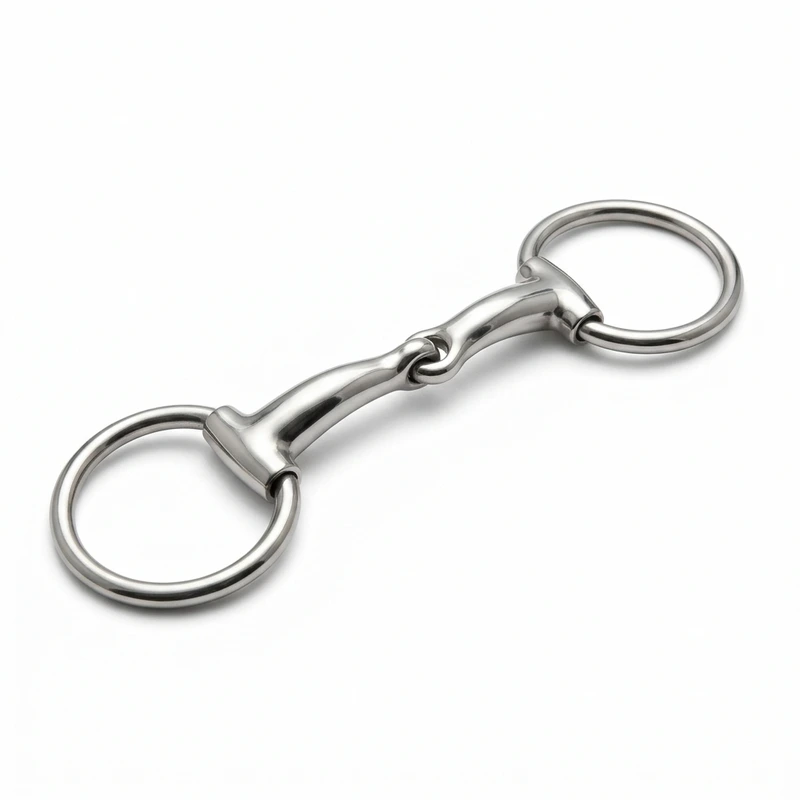
For an FEI-oriented OEM line, the product file should identify the intended configuration, such as loose-ring snaffle, eggbutt snaffle, full-cheek snaffle where permitted, bridoon, or curb bit. The file should include a dimensioned drawing, material declaration, photographs of the complete assembled bit, mouthpiece profile, joint detail, cheek dimensions, and a statement that the current FEI rules must be checked before competition.
FEI dressage equipment provisions generally require a smooth bit without sharp or injurious surfaces and prescribe permitted configurations for snaffles and double bridles. Do not print an unsupported universal claim that 14 mm, 16 mm, or 18 mm is automatically legal in every FEI class. The relevant rulebook and steward interpretation control. Product literature should direct riders and distributors to the current FEI publication and the national federation’s implementation guidance.
British Equestrian and affiliated discipline rules may use similar welfare principles while applying their own permitted-bit lists, dimensions, and inspection procedures. A product intended for British competition should be reviewed against the current discipline-specific regulations rather than relying on a historical catalogue statement.
VG1 01.040 is a riding-helmet standard, not a horse-bit material standard. It should not be cited as evidence that a bit is compliant. Helmet conformity and bit conformity are separate product-control matters.
Manufacturing and Quality Control in Sialkot
Incoming Material Control
- Assign a heat, batch, or coil identity to every metal input.
- Review the supplier certificate for chemical composition, grade, condition, and traceability.
- Use XRF screening on incoming copper alloys and stainless steel, with laboratory escalation for disputed or high-value production.
- Reject unidentified mixed scrap for mouth-contact components.
- For Chrome Vanadium cheek hardware or tooling, specify the applicable grade, forging condition, heat treatment, and hardness range separately from the mouthpiece alloy.
Forming, Machining, and Joint Assembly
- Control forged or cast blanks for laps, folds, shrinkage cavities, cracks, and incomplete filling.
- Maintain a drawing-based dimensional system covering mouthpiece diameter, cheek length, ring diameter, joint position, and symmetry.
- Use controlled polishing that removes tool marks without reducing the mouthpiece below the stated minimum diameter.
- Check all joints for smooth articulation through the full intended movement range.
- Confirm that no pin, hinge, weld, or ring transition creates a sharp edge, pinch point, or exposed burr.
Inspection Parameters
| Control point | Suggested acceptance requirement | Inspection method |
|---|---|---|
| Mouthpiece diameter | Drawing nominal ±0.20 mm unless a tighter tolerance is agreed | Calibrated digital caliper at multiple clock positions |
| Roundness and ovality | Maximum 0.20 mm deviation for a round profile, unless design-specific | Micrometer or profile gauge |
| Surface condition | No burrs, pits, cracks, sharp grinding marks, flaking, or green corrosion deposits | Visual inspection under 500–1,000 lux and tactile inspection with a clean cloth |
| Joint movement | Free movement without binding, excessive looseness, or pinch exposure | Manual articulation and fit-check gauge |
| Alloy verification | Conforms to the purchase specification and declared alloy grade | XRF screening, certificate review, and periodic laboratory confirmation |
| Durability | No cracking, deformation, sharp exposure, or functional failure after agreed cyclic testing | Rein-controlled laboratory cycling and post-test dimensional inspection |
| Corrosion resistance | No harmful pitting, flaking, or rough corrosion after the agreed wet-saliva simulation | Controlled electrolyte exposure, rinse, dry, and magnified inspection |
Bit durability testing should use the intended rein direction and realistic repeated loading rather than a single static pull test. A factory quality plan may include 10,000 to 25,000 cyclic loading events for comparative design validation, followed by inspection of the mouthpiece, rings, hinges, welds, and cheek transitions. The exact force and cycle profile should be agreed with the buyer because a lightweight snaffle and a leveraged curb design are not tested identically.
Leather and Bridle Interface Specifications
When the bit is supplied as part of a bridle, the leather specification must be controlled independently from the metal specification. A suitable premium requirement is vegetable-tanned, drum-dyed Argentine cowhide with full batch traceability. The purchase order should state hide selection, usable thickness, tanning method, dye penetration, moisture conditioning, finish, tensile performance, and hardware compatibility.
| Leather parameter | Suggested OEM specification | Reason for control |
|---|---|---|
| Leather source | Argentine cowhide, traceable tannery batch | Controls fibre structure, substance, and repeatability |
| Tanning | Vegetable tanning in controlled drums with documented float, temperature, pH, and retannage sequence | Supports consistent firmness, burnish, and long-term conditioning |
| Dye method | Drum-dyed through-colour, not surface-only pigment coating | Reduces visible colour loss at punched holes and folded edges |
| Thickness | 4.0–4.5 mm for principal crown and cheek straps; 2.5–3.2 mm for selected keepers and adjustment straps | Balances strength, flexibility, and buckle compatibility |
| Thickness tolerance | ±0.20 mm for principal straps unless the drawing states otherwise | Prevents inconsistent fit and hardware engagement |
| Physical condition | No loose flesh, deep scars, open grain, excessive stretch, dye migration, or unsealed cut edges | Protects durability and horse-contact comfort |
| Finishing | Edge bevel, burnish, conditioning, and controlled top finish without brittle cracking | Reduces strap edge wear and moisture penetration |
Leather components should be tested for buckle-hole tear resistance, stitch security, fold endurance, colour transfer under damp rubbing, and dimensional stability after conditioning. The bit and bridle should be inspected as a complete assembly so that ring movement, cheek strap alignment, throatlatch adjustment, and browband clearance do not compromise the horse’s comfort.
Buyer RFQ and Wholesale OEM Ordering Checklist
- Product architecture: State snaffle, bridoon, curb, double-bridle component, loose-ring, eggbutt, D-ring, full-cheek, or another defined configuration.
- Alloy: Specify German Silver at 65% Cu, 23% Zn, and 12% Ni; Aurigan only with authorized material traceability; or AISI 304/304L with the required chemical limits.
- Nickel declaration: Confirm whether nickel is present and require an alloy certificate for each production batch.
- Mouthpiece diameter: Select 14 mm, 16 mm, or 18 mm and define the exact measurement location and tolerance.
- Profile: Define single-jointed, double-jointed, mullen, ported, barrel, low-port, or another profile with a dimensioned drawing.
- Edge and joint geometry: Specify minimum edge radius, joint-bar transition, ring clearance, and maximum permissible burr or surface discontinuity.
- Cheek material: Identify stainless steel, high-copper alloy, Chrome Vanadium drop-forged hardware, or another approved grade separately from the mouthpiece.
- Surface finish: State bright polish, satin, brushed, or controlled antique finish and prohibit flaking plating or abrasive residue.
- Testing: Require XRF alloy screening, dimensional inspection, articulation testing, cyclic durability testing, corrosion challenge, and final visual inspection.
- Rulebook target: Identify FEI dressage, British Equestrian, national federation, racing, eventing, or general schooling use. Require the buyer to confirm current legal status before competition.
- Leather specification: For bridles, state vegetable drum-dyed Argentine cowhide, thickness, tolerance, dye penetration, edge finish, and hardware plating or stainless grade.
- Packaging: Require individual protective bags, alloy and care information, batch coding, barcode or private-label artwork, and moisture-controlled cartons.
- Quality agreement: Define AQL, sample size, defect classification, corrective-action procedure, and retained production samples.
- Commercial details: State annual volume, first-order quantity, size ratio, colour, logo method, target Incoterm, lead time, pre-production sample requirement, and replacement policy.
Procurement Conclusion and Equestrian Max Manufacturing Support
German Silver and other copper-rich alloys can provide rapid thermal equilibration, a distinctive mouth feel, and a visually differentiated product line. AISI 304 stainless steel provides a familiar, stable, low-maintenance material platform when the surface is correctly finished and the joints are properly engineered. Neither alloy substitutes for correct bit fit, competent dental care, appropriate rein handling, or inspection under the applicable welfare and competition rules.
For wholesale product development, review the complete range at Equestrian Max products, including horse bits and bridles, English saddles and saddlery, farrier and hoof-care tools, and equine dental instruments. To issue an alloy-controlled RFQ, submit drawings, target volumes, rulebook destination, packaging requirements, and inspection criteria through the Equestrian Max contact page.
Related Categories & Sourcing Hubs
Claire Pemberton
FEI Horse Bit Metallurgy & Tack Procurement Specialist
Reviewed against FEI tack regulations, high-copper German Silver bit metallurgy, Chrome-Vanadium farrier forging, and equine dental standards.

