Dee Ring vs. Loose Ring Snaffles: Lateral Turning Pressure, Pinch Prevention & Mouthpiece Thickness Ratios
Biomechanical comparison of Dee-Ring and Loose Ring snaffle bits: lateral cheek stability, lip pinching prevention, copper roller barrels, and young horse training mechanics.
On this page (9)
- Dee Ring vs. Loose Ring Snaffles: Lateral Turning Pressure, Pinch Prevention & Mouthpiece Thickness Ratios
- Executive Overview and B2B Procurement Context
- How Dee and Loose Rings Change Lateral Turning Pressure
- Ring Diameter, Mouthpiece Thickness, and Fit Ratios
- Materials and Metallurgical Engineering
- Biomechanical and Welfare Considerations
- Sialkot Manufacturing, Quality Control, and Inspection Checkpoints
- Buyer RFQ and OEM Ordering Checklist
- Procurement Conclusion
Dee Ring vs. Loose Ring Snaffles: Lateral Turning Pressure, Pinch Prevention & Mouthpiece Thickness Ratios
Executive Overview and B2B Procurement Context
Dee-ring and loose-ring snaffles are both direct-action bits, but their cheek geometry produces materially different lateral guidance, stability, lip-contact behavior, and reins-to-mouthpiece alignment. For a tack distributor, professional rider, farrier, or equine veterinary hospital purchasing department, the relevant specification is not simply “Dee” or “loose ring.” The purchase decision should define cheek-ring diameter, mouthpiece thickness, joint configuration, alloy, surface finish, dimensional tolerance, and inspection method.
A fixed Dee cheek resists the bit pulling through the mouth when one rein is applied. Its broad, stable cheek also provides a clearer lateral turning signal against the opposite side of the horse’s face. Correctly sized Dee cheeks can reduce movement at the lip commissures, but an undersized or poorly finished design may still press or pinch the lip between the cheek and mouthpiece. A loose ring allows the mouthpiece to rotate and settle more independently, permitting the horse to position the bit naturally. It generally offers greater mobility, but the open ring-to-mouthpiece interface requires careful control of clearance, edge radius, and bit width to prevent lip capture.
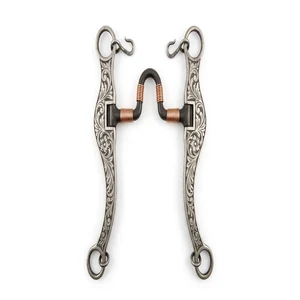
Center-revolving copper rollers add localized movement and a conductive, warm-feeling contact surface that may encourage calm mouthing in some horses. A double-jointed mouthpiece with an oval lozenge distributes bending across two joints and avoids the concentrated central fold associated with a single-jointed “nutcracker” action. These features must not be treated as substitutes for correct fitting, rein handling, dental assessment, or compliance with the applicable competition rules.
For wholesale and OEM procurement, Equestrian Max can coordinate the bit, bridle, saddle, hoof-care, and equine dental tool categories through the complete product range, including horse bits and bridles, English saddles and saddlery, farrier and hoof-care tools, and equine dental instruments.
How Dee and Loose Rings Change Lateral Turning Pressure
Fixed Dee cheek
The Dee cheek forms a relatively stable lateral frame on each side of the horse’s mouth. When the rider shortens one rein, the fixed cheek limits mouthpiece migration toward the active side and transfers part of the rein force to the cheek, lip, and facial tissues on the opposite side. This produces a more distinct turning boundary than a freely rotating ring.
The fixed cheek also prevents the mouthpiece from pulling through the lips when the bit is correctly fitted and the cheek diameter is appropriate. Its stability is particularly useful for young horses, horses that evade a loose ring by drawing the mouthpiece sideways, and riders requiring predictable lateral response. However, the Dee does not automatically eliminate pinching. The mouthpiece end, cheek transition, and ring aperture must be smoothly radiused, and the bit must be wide enough to avoid compressing the lip commissures.
Loose ring
A loose ring rotates around the mouthpiece end and allows the horse to make small positional adjustments as the tongue, bars, lips, and lower jaw move. This free play can reduce the sensation of a fixed metal frame and may help a horse find a comfortable resting position. It also permits more independent movement between the reins and the mouthpiece.
The trade-off is reduced lateral stability. Under a single-rein action, the mouthpiece may slide toward the active side, and the ring can approach the lip commissure. Loose-ring designs therefore require close control of ring-to-lip clearance, smooth ring apertures, correct bit width, and, where appropriate, correctly fitted bit guards. A loose ring that is too narrow can pinch; one that is excessively wide can shift laterally and create inconsistent rein communication.
Center-revolving copper rollers
A center roller should rotate freely without lateral looseness that could create sharp loading or excessive noise. A practical production target is 0.20–0.50 mm radial clearance around the roller axle or center spindle, subject to the selected construction. The roller should have a continuous edge radius of at least 0.50 mm, with no burrs, tool marks, or interrupted plating.
High-copper contact surfaces are commonly selected for their warm tactile response and resistance to becoming brittle at normal bit thicknesses. Copper rollers should be specified as a controlled alloy rather than an unidentified copper-colored coating. A purchaser should request alloy declaration, plating disclosure, surface-finish data, and a confirmation that no flaking coating is used on the horse-contact surface.
Double-jointed oval lozenge
A double-jointed mouthpiece has two articulation points and an oval central lozenge. Compared with a conventional single-jointed mouthpiece, the oval lozenge reduces the likelihood of a single sharp central fold pressing downward while the reins are applied. It also distributes the bend across the two joints and presents a broader central contact surface to the tongue.
The design still requires controlled geometry. Excessively short center links can create concentrated pressure, while excessively long links may increase movement and contact the palate depending on the horse’s anatomy and rein action. Recommended OEM drawings should identify center-link length, joint-axis spacing, mouthpiece diameter, edge radius, and the maximum angular travel of each joint.
Ring Diameter, Mouthpiece Thickness, and Fit Ratios
Common ring diameters for these snaffles are 65 mm, 70 mm, and 75 mm, measured across the outside diameter unless the purchase drawing states otherwise. A 65 mm ring is compact and can suit buyers prioritizing reduced cheek projection. A 70 mm ring provides a balanced general-purpose specification. A 75 mm ring offers a larger visual and lateral frame and may be selected where additional cheek stability or hand clearance is required.
Ring diameter is not a substitute for bit width. The mouthpiece should be measured from the outer face of one mouthpiece end to the outer face of the opposite end, with the required fitting allowance defined by the buyer. A typical finished-width tolerance for a standard OEM run is ±1.0 mm, while a tighter premium specification may require ±0.5 mm after polishing.
For a 14 mm mouthpiece, the ring-to-mouthpiece diameter ratios are approximately 4.64:1, 5.00:1, and 5.36:1 for 65 mm, 70 mm, and 75 mm rings respectively. For a 16 mm mouthpiece, the equivalent ratios are 4.06:1, 4.38:1, and 4.69:1. A thinner 14 mm mouthpiece offers more room for the tongue and may provide a sharper pressure response, whereas a 16–18 mm mouthpiece presents a broader contact area and occupies more oral space. The correct choice depends on the horse’s tongue volume, palate conformation, bar sensitivity, lip thickness, and the rider’s rein action.
| Configuration | Typical ring outside diameter | Recommended mouthpiece range | Lateral and movement behavior | Primary procurement risk | Recommended inspection target |
|---|---|---|---|---|---|
| Fixed Dee, single-jointed | 65, 70, or 75 mm | 14–18 mm | Stable cheek guidance; resists pull-through; stronger lateral framing | Central fold and lip pressure if geometry or fit is incorrect | Joint smoothness, cheek symmetry, edge radius, and width |
| Fixed Dee, double-jointed oval lozenge | 65, 70, or 75 mm | 14–18 mm | Stable cheek with more progressive bending and reduced single-joint fold | Over-short center link or excessive joint travel | Center-link length, articulation angle, and lozenge edge radius |
| Loose ring, single-jointed | 65, 70, or 75 mm | 14–18 mm | Free rotation and natural positioning; less fixed lateral influence | Ring-to-lip capture, sliding, or inconsistent rein alignment | Ring aperture, smooth rotation, mouthpiece width, and burr control |
| Loose ring, double-jointed oval lozenge | 65, 70, or 75 mm | 14–18 mm | Highest component mobility with progressive two-joint bending | Excessive free play or narrow lip clearance | Rotational clearance, joint travel, surface finish, and bit guards where specified |
| Dee with center copper roller | 65, 70, or 75 mm | 14–18 mm | Fixed lateral frame with localized central movement and mouthing stimulus | Roller seizure, loose axle, copper surface degradation | 0.20–0.50 mm functional clearance, rotation, and roller edge radius |
| Loose ring with center copper roller | 65, 70, or 75 mm | 14–18 mm | Free cheek movement combined with central roller activity | Combined ring movement and roller looseness causing unpredictable contact | Ring rotation, roller rotation, axial play, and complete burr inspection |
| Premium double-jointed OEM specification | Buyer-defined, commonly 70 mm | 14, 16, or 18 mm | Controlled lateral geometry with documented mouthpiece ratios | Uncontrolled variation between production batches | 100% visual check plus sampling by calibrated gauges and go/no-go fixtures |
Materials and Metallurgical Engineering
High-copper German Silver and Argentan
“German Silver” or “Argentan” is a copper-nickel-zinc alloy and does not contain elemental silver unless separately declared. For a high-copper equestrian bit specification, Equestrian Max recommends defining the chemistry by purchase order rather than relying on the trade name. A practical target is copper 60–65% by mass, nickel 12–18%, zinc balance, with iron controlled below 0.50% and lead, cadmium, and other restricted contaminants controlled to the buyer’s applicable market limits.
Where a buyer requires the traditional approximately 60/20/20 German Silver composition, the drawing should state Cu 59–62%, Ni 18–22%, Zn balance. Material verification should be performed by handheld or bench X-ray fluorescence on incoming lots, with heat or batch traceability maintained through forging, machining, polishing, and packing.
The mouthpiece should be free from exposed ferrous inclusions, deep draw marks, casting porosity, and sharp discontinuities. A polished contact surface should normally achieve approximately Ra 0.4–0.8 µm after final finishing, unless the buyer requests a different tactile finish. The manufacturer should document alloy condition, hardness range, and whether the component was forged, machined, or assembled from drawn tube.
AISI 420 stainless steel
AISI 420 is a martensitic stainless steel generally specified at approximately 0.15–0.40% carbon and 12.0–14.0% chromium, with manganese and silicon commonly controlled near 1.0% maximum each and sulfur and phosphorus commonly controlled near 0.04% maximum each. The precise mill certificate remains the controlling document.
For cheek plates, pins, axles, and wear-sensitive components, a heat-treated AISI 420 specification may target approximately 44–50 HRC, subject to section thickness and the required balance between wear resistance and toughness. A lower hardness may be preferable for parts exposed to impact or repeated articulation. Final polishing should remove heat-tint, sharp machining marks, and surface discontinuities before assembly.
Chrome Vanadium drop-forged components
Chrome Vanadium steel is appropriate for high-load forged buckles, rein components, farrier tools, and selected hardware where toughness and repeated load resistance are required. A representative chemistry is carbon 0.48–0.53%, chromium 0.80–1.10%, manganese 0.70–0.90%, silicon 0.15–0.35%, and vanadium approximately 0.15–0.25%, subject to the selected mill standard.
Drop-forged components should be forged above the alloy’s appropriate forming temperature, normalized or quenched and tempered according to the material certificate, and inspected for laps, cracks, incomplete fill, and die mismatch. A typical finished die-parting mismatch limit is 0.25 mm or less on visible load-bearing surfaces, with flash fully removed and edges blended to the approved drawing.
Leather interfaces and saddlery packaging
When the bit is supplied as part of a bridle or OEM saddlery set, the leather specification should identify vegetable-tanned, drum-dyed Argentine cowhide, commonly 2.8–3.5 mm for cheek straps and 3.5–4.5 mm for higher-load crown or rein components. A buyer may specify a target moisture content of 12–18% at dispatch, pH approximately 3.5–5.5, and a minimum tear-strength or tensile-strength value appropriate to the selected leather weight and construction.
Drum dyeing should provide consistent penetration through the cross-section, while vegetable tanning should be documented by tannery batch, hide selection, thickness mapping, and finish system. Finished leather should be checked for loose grain, excessive stretch, edge cracking, dye transfer, and stitch-hole pull-out. Hardware contact points must not abrade the leather during normal articulation.
Biomechanical and Welfare Considerations
The bit contacts the lips, bars, tongue, and, depending on conformation and rein tension, the palate. The tongue occupies a substantial portion of the oral cavity and its available space varies between horses. Thick mouthpieces are not automatically milder if they crowd the tongue, while thin mouthpieces are not automatically harsher if the horse has adequate room and the rider uses light, stable rein contact.
The lower jaw, lip commissures, facial tissues, and bars should be considered together. A Dee cheek can improve lateral clarity but may transmit more cheek-side pressure during a strong unilateral rein action. A loose ring can reduce fixed cheek pressure but may move closer to the lip commissure. Fit, rein tension, rider balance, dental condition, and individual response must therefore be assessed as a complete system.
For competition supply, the buyer should verify current FEI discipline rules, British Equestrian regulations where applicable, and the relevant national equipment schedule before selecting a mouthpiece, roller, cheek configuration, or bit guard. VG1 01.040 primarily concerns safety requirements for riding helmets and should not be treated as a bit-material standard; helmet compliance must be specified separately when a complete riding-equipment program is purchased.
Sialkot Manufacturing, Quality Control, and Inspection Checkpoints
Incoming material control
- Record the supplier heat number, material grade, chemistry, and delivery condition for every metal lot.
- Use X-ray fluorescence screening for copper alloys, stainless steel, and Chrome Vanadium identification, with laboratory confirmation when the order requires full certification.
- Inspect leather hides for thickness variation, loose grain, scars, color inconsistency, moisture, and drum-dye penetration before cutting.
Forming, machining, and assembly control
- Verify ring outside diameter at 65, 70, or 75 mm according to the approved drawing, with a standard dimensional tolerance of ±0.50 mm unless otherwise agreed.
- Check mouthpiece diameter at multiple points; a recommended production tolerance is ±0.20 mm for machined metal sections and ±0.30 mm for formed sections.
- Use go/no-go gauges for ring apertures, center links, axle pins, and cheek-to-mouthpiece clearances.
- Confirm that Dee cheeks are symmetrical and that the mouthpiece is centered within ±1.0 mm across the finished assembly.
- Measure loose-ring axial play and radial play against the approved design. Excessive play is unacceptable even when the ring rotates freely.
- Check that every articulation point moves smoothly through the specified travel without binding, clicking caused by burrs, or sharp contact during full rotation.
- Verify roller rotation after polishing and assembly. A roller that stops immediately under light finger force should be segregated for rework or rejection.
Surface, durability, and batch release
- Inspect 100% of horse-contact surfaces under bright angled light for burrs, pits, folds, cracks, plating defects, and abrasive marks.
- Target a polished surface roughness of approximately Ra 0.4–0.8 µm on mouth-contact areas, unless the approved product drawing states otherwise.
- Conduct repeated articulation and rein-load simulation on representative samples. The test fixture should apply the buyer’s specified load and cycle count, with no cracking, joint seizure, roller detachment, or unacceptable permanent deformation.
- Use dye penetrant inspection on selected ferrous forged components where the risk assessment or buyer specification requires crack detection.
- Perform salt-spray or corrosion testing only when relevant to the selected finish and market requirement; test duration and acceptance criteria must be written into the purchase order rather than assumed.
- Maintain first-article approval, in-process inspection records, final sampling records, carton identification, and traceability from finished product to metal and leather batches.
Buyer RFQ and OEM Ordering Checklist
- Cheek style: Specify fixed Dee or loose ring, with ring diameter measured as outside diameter or by another defined method.
- Ring diameter: Select 65 mm, 70 mm, 75 mm, or a custom size, including dimensional tolerance.
- Bit width: State the finished mouthpiece width, measuring method, fitting allowance, and tolerance.
- Mouthpiece thickness: Specify 14 mm, 16 mm, 18 mm, or another dimension, together with the required ring-to-mouthpiece ratio.
- Joint configuration: Define single-jointed, double-jointed, oval lozenge, center roller, or combined construction.
- Lozenge geometry: State center-link length, width, thickness, articulation-axis spacing, and permitted angular travel.
- Roller specification: Identify copper alloy, roller diameter, axle material, clearance, edge radius, and rotation requirement.
- Metal chemistry: Request the exact percentage range for high-copper German Silver or Argentan and identify any restricted substances.
- Stainless components: Specify AISI 420 or another approved grade, hardness range, heat treatment, and corrosion-finish requirement.
- Forged hardware: State Chrome Vanadium grade, forging method, heat treatment, hardness, die-mismatch limit, and crack-inspection requirement.
- Surface finish: Define polish level, maximum roughness, edge radii, color, and whether plating or coating is permitted on horse-contact areas.
- Leather package: For associated bridles, specify vegetable-tanned, drum-dyed Argentine cowhide, thickness, colorfastness, moisture range, stitching, edge finish, and hardware.
- Compliance file: Request drawings, material declarations, batch records, inspection reports, and confirmation of suitability for the intended FEI or national rule environment.
- Sampling: Define first-article quantity, pre-production sample approval, AQL or buyer-specific sampling plan, and retention samples.
- Packaging: State individual bagging, protective separators, barcode requirements, carton quantity, product labeling, country-of-origin marking, and export documentation.
- Commercial terms: Include MOQ, tooling ownership, lead time, Incoterm, replacement policy, warranty scope, and permitted production variation.
Procurement Conclusion
The Dee-versus-loose-ring decision should be made from the intended lateral response, lip-compression risk, horse’s oral conformation, mouthpiece thickness, and rider contact—not from ring style alone. A fixed Dee offers greater resistance to pull-through and clearer lateral framing. A loose ring provides more free play and allows the horse to position the mouthpiece more naturally, but demands tighter control of ring clearance and finishing. Double-jointed oval lozenges and center-revolving copper rollers can refine the contact profile when their dimensions, materials, and movement are properly controlled.
For an OEM quotation, submit the required ring diameter, mouthpiece ratio, alloy chemistry, tolerances, finish, test plan, packaging, and compliance destination. To discuss custom bit production or a coordinated saddlery and equine-tool program, contact Equestrian Max manufacturing and technical sales.
Claire Pemberton
FEI Horse Bit Metallurgy & Tack Procurement Specialist
Reviewed against FEI tack regulations, high-copper German Silver bit metallurgy, Chrome-Vanadium farrier forging, and equine dental standards.